Executive summary
AI in agriculture works best when it begins with the farmer: local knowledge, crop conditions, and practical decisions about water, inputs, and risk. Guided by FAO principles, precision farming becomes less about automation for its own sake and more about helping growers monitor fields, detect disease earlier, validate tools locally, and keep control over agronomic decisions.
The practical answer: AI in agriculture works only when farmers remain in control
The real value of artificial intelligence in agriculture is not that it replaces farm judgment, but that it strengthens it. In FAO-aligned precision farming, AI should help farmers see earlier, decide faster, and use scarce resources more carefully. That matters because crop losses, water stress, pest pressure, labor shortages, and market volatility all arrive on farms as intertwined risks, not as isolated technical problems. The business case is straightforward: better timing, lower waste, and more targeted interventions can improve operational resilience, but only if the tools fit local agronomy, connectivity, and farm economics.
This is why the strongest use of AI in agriculture starts with the farmer’s questions: Which field needs attention first? Where is irrigation underperforming? Is this leaf symptom a disease, nutrient issue, or heat stress? Should I spray, wait, scout, or adjust the irrigation schedule? AI is useful when it answers those questions in ways that are timely, explainable, and affordable. It is not useful when it adds complexity, depends on perfect data, or pushes decisions away from the person who understands the crop and the land.
Crop monitoring, disease detection, and forecasting: from images to decisions
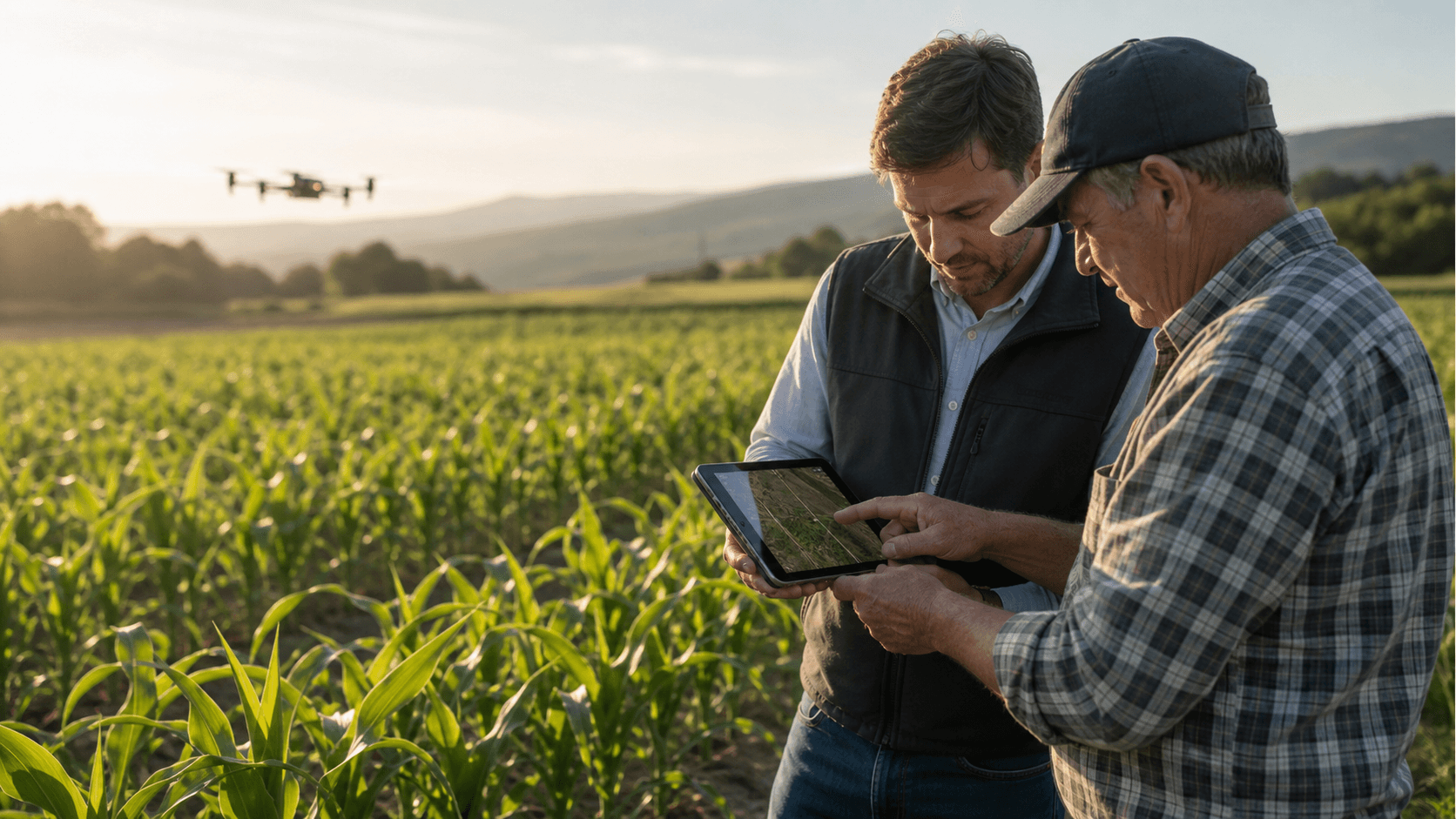
FAO guidance emphasizes using digital tools to support surveillance, early warning, and evidence-based management. In practice, AI can process satellite imagery, drone photos, and smartphone images to flag crop variability, pest damage, water stress, or disease symptoms. The value is not the image alone; it is the workflow that follows. A useful system identifies where field scouting should happen, what should be checked, and how urgent the response may be. That can reduce blind blanket action and help growers focus labor where it matters most.
Disease detection deserves special care. AI can classify visible symptoms, but symptoms are not the same as diagnosis. Similar leaf patterns may come from different pathogens, nutrient deficiencies, herbicide drift, or weather injury. For that reason, local validation is essential. Models should be tested against regional crop varieties, local disease pressure, and field conditions before they are trusted for operational advice. Forecasting works best in the same way: when weather, soil, and pest models are combined with local observation, farmers can plan planting, spraying, and harvest more confidently. But forecasts are probabilities, not promises, and they should always be communicated with uncertainty.
Water and input optimization: precision only matters if it reduces waste responsibly
Water optimization is one of the clearest uses of AI in agriculture. When AI ingests soil moisture readings, weather forecasts, evapotranspiration estimates, and crop stage data, it can support irrigation scheduling that avoids both under-watering and excess application. The same logic applies to fertilizer and crop protection products. Variable-rate recommendations can help match inputs to field needs instead of treating every hectare the same. That can lower input waste, reduce runoff risk, and improve cost discipline.
Still, optimization has tradeoffs. Sensors fail, data gaps happen, and models can overfit to a single season. If a recommendation is too complex to execute with available labor or equipment, it may not be practical at all. A good deployment therefore starts with a narrow use case, such as irrigation scheduling in one crop or scouting support for one pest. It should measure whether decisions are actually changing, whether the recommendations are being followed, and whether those changes improve resource use without increasing agronomic risk. Precision farming is not about maximizing every input reduction; it is about using the right amount at the right time for the right reason.
Robotics, rural connectivity, and the limits of automation
Robotics can extend AI from insight to action through weeding robots, autonomous sprayers, greenhouse monitoring systems, or machine vision in harvesting and sorting. In controlled environments, these tools can improve consistency and reduce repetitive labor. In open fields, however, robotics is more constrained by terrain, crop diversity, power supply, safety, and maintenance capacity. The question is not whether the technology is advanced, but whether local operators can deploy, repair, and trust it.
Connectivity is often the hidden bottleneck. Many AI systems assume stable broadband, frequent cloud synchronization, and uninterrupted access to digital services. FAO’s broader digital inclusion perspective is important here: rural infrastructure, device affordability, local language interfaces, and training determine whether AI becomes a farm tool or a demonstration project. Offline-first design, edge processing on the device itself, and low-bandwidth data exchange can make systems more resilient. Equally important is farmer control over data: growers should know what is collected, where it goes, who can access it, and how it is used. Without that transparency, adoption will remain limited.
Inclusion, measurement, and a short action plan for responsible adoption
The benefits of AI in agriculture should not be reserved for the largest or most connected farms. Smallholders, tenant farmers, women farmers, and producers in remote areas often face the greatest barriers to information and services. Inclusive design means local language support, simple interfaces, handset compatibility, advisory formats that work by SMS or voice where needed, and tools that complement—not replace—extension services and cooperative networks. It also means designing for affordability, because a technically elegant system that cannot be maintained is not sustainable.
Measurement should be operational, not promotional. Track whether AI helps reduce unnecessary field visits, improves irrigation timing, increases detection of issues earlier in the season, or supports more targeted interventions. Also measure failure modes: false alerts, unusable recommendations, downtime, and user trust. A short action plan is sensible. First, define one farmer problem with clear economic relevance. Second, pilot locally with extension agents and growers. Third, validate against field observations across more than one season. Fourth, build in data governance, language access, and offline use. Fifth, expand only after the tool proves useful in real conditions. That is how precision farming starts with the farmer and stays useful over time.
Sources & further reading
Primary reporting and references used to inform this analysis.
- 01International Federation of Robotics
AI in Robotics — Trends, Challenges, Commercial Applications - 02NHTSA
Automated Vehicle Safety - 03FAO
Digital Agriculture and AI Innovation - 04NIST
2026 Roadmap on Artificial Intelligence and Machine Learning for Smart Manufacturing - 05Bank for International Settlements
Intelligent financial system: how AI is transforming finance - 06PROMPERÚ
Marco normativo y regulatorio de la Inteligencia Artificial en Perú y su impacto en el comercio exterior
NexaSphere Perspective
Build what comes next.
Turn emerging AI capabilities into a secure, measurable growth system designed around your business.
Discuss your AI roadmap