Executive summary
Self-driving AI is not a single feature but a safety case: a disciplined argument that a vehicle can operate within a defined operational design domain, detect when conditions exceed its limits, and transition to a minimal-risk state. For businesses, the difference between driver assistance and automated driving is not semantic; it determines liability, testing, deployment scope, and how trust is earned. The winning approach is to validate narrowly, monitor continuously, and communicate capabilities without overselling them.
The real question is not whether the demo worked; it is whether the system can stay safe when the demo conditions disappear.
That is the central business issue in self-driving AI. A polished ride on a closed route can show technical progress, but it does not answer the harder question regulators, insurers, operators, and passengers care about: what happens when weather changes, lane markings fade, a sensor is occluded, a map is stale, or a pedestrian behaves unpredictably? The safety case starts there. In NHTSA terms, driver assistance systems support a human driver, while automated driving systems are designed to perform the driving task itself within a defined scope. That distinction matters because it changes who is expected to supervise, when the system may operate, and what evidence is needed before deployment.
For companies building or buying these systems, the strategic implication is simple: value comes from proving reliability in a bounded environment, not from implying general-purpose autonomy. Overstating readiness can create legal exposure, slow procurement, and damage public trust. A narrower claim that is well validated is often more commercially durable than a broad claim that cannot be defended.
Start with the operational design domain, because safety is always contextual.
The operational design domain, or ODD, is the set of conditions under which an automated driving system is intended to operate. It may include geography, road type, speed range, traffic complexity, lighting, weather, and even permitted maneuvers. The ODD is not a marketing detail; it is the boundary condition for safety engineering. If the system is only validated for clear-weather highway driving in a specific region, then that is where it must be described as capable. Outside that domain, performance assumptions break down.
Implementation guidance begins with making the ODD explicit in product requirements, user interfaces, fleet policies, and internal test plans. Teams should define not only where the system can drive, but where it must refuse to drive, degrade gracefully, or hand control back. This helps avoid the most common failure mode in autonomy programs: capability drift, where a system is quietly used beyond the conditions it was validated for. The tradeoff is commercial flexibility. A tight ODD can limit near-term scale, but it usually improves safety confidence and makes regulatory conversations more concrete.
Validation should measure edge cases, not just average performance.
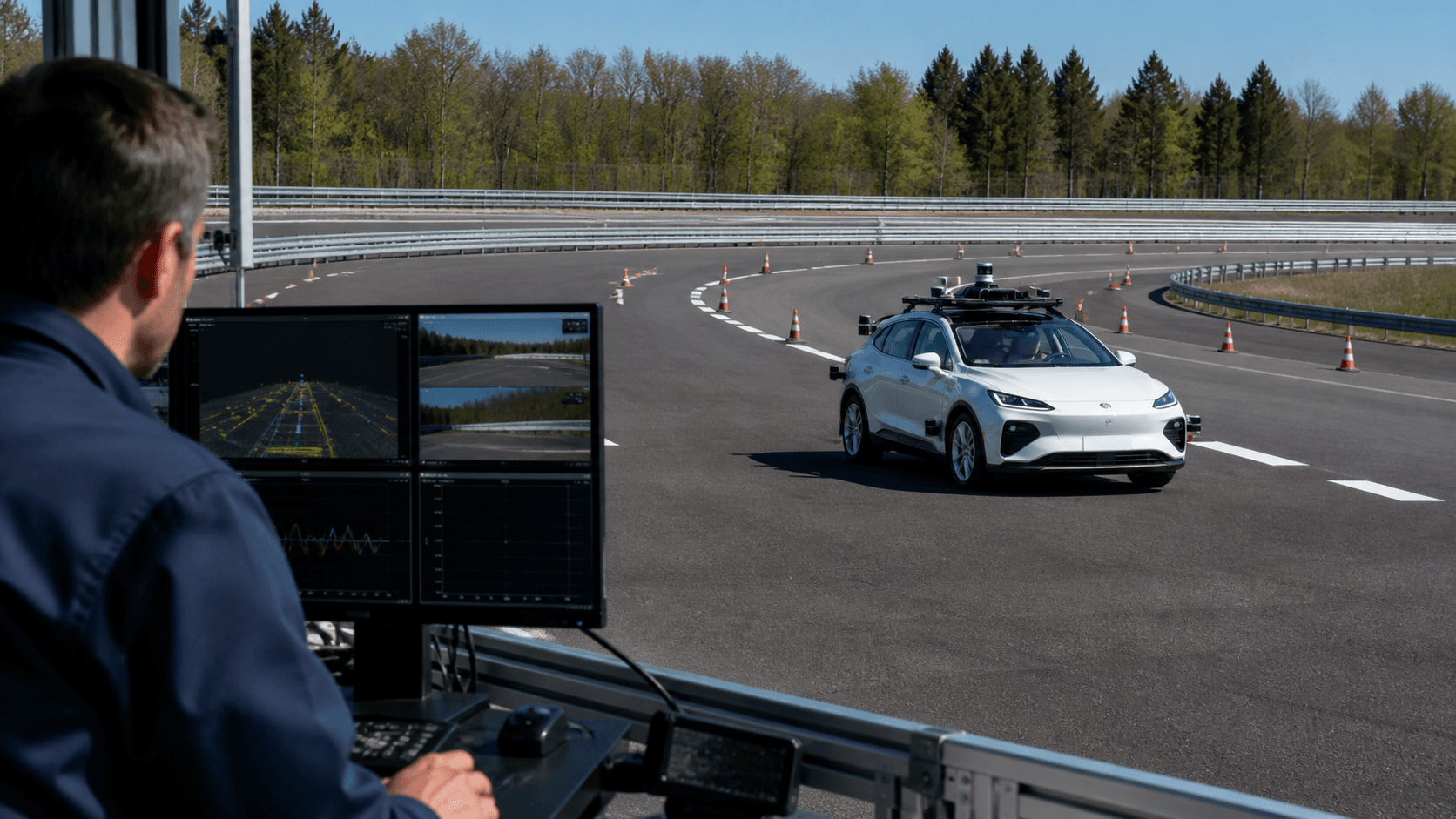
A credible safety case depends on validation that combines simulation, closed-course testing, and carefully supervised real-world exposure. The goal is not to produce a perfect score; it is to understand failure modes, residual risk, and the conditions under which the system becomes uncertain. Validation should examine sensor performance, perception in poor visibility, prediction around vulnerable road users, planning in dense traffic, and behavior when signals conflict. It should also test transitions: what happens when the system reaches the edge of its ODD, when a map update fails, or when a component degrades.
Measurement should be tied to operational questions. Useful metrics may include disengagements, intervention rates, detection latency, false positives and false negatives in object recognition, and the system’s ability to initiate a minimal-risk condition. But no single metric proves safety. Leaders should resist the temptation to treat aggregate miles driven as sufficient evidence. Exposure matters, yet so does scenario coverage. A thousand uneventful miles do not meaningfully de-risk a rare but severe edge case. The more responsible approach is a scenario-based validation plan that prioritizes known hazards and documents what remains unproven.
Fallback and monitoring are the difference between assistance and autonomy that can be trusted.
In automated driving, fallback is essential. If the system cannot continue safely, it must detect the limitation and transition to a minimal-risk state, such as slowing, pulling over, stopping, or handing control to a human driver when one is present and prepared. This is not a secondary feature; it is part of the safety architecture. For driver assistance systems, fallback often means rapid human takeover. For automated driving systems, fallback must be designed into the machine behavior itself because there may be no immediately available human to rescue the situation.
Continuous monitoring must cover the vehicle, the environment, and the human-machine interface. The system should know when its sensors are degraded, when confidence is low, and when the current conditions exceed the ODD. Operators also need fleet-level monitoring, incident review, and software change control. That creates a tradeoff: more monitoring can improve safety and traceability, but it also increases complexity, cost, and the risk of alert fatigue. The goal is not to monitor everything equally; it is to monitor the failure states that matter most and to make escalation pathways unambiguous.
Public trust is earned through restraint, clarity, and auditable behavior.
Trust in self-driving AI will not come from slogans. It will come from consistency between what the system says, what the company claims, and what the vehicle actually does. Clear labeling matters. So does training for users, operations teams, and first responders. Public-facing language should distinguish assistance from automation and explain the conditions required for safe use without implying human-level generalization. When companies describe capabilities precisely, they reduce the chance of misuse and make it easier for regulators and customers to assess the system honestly.
There is also a governance dimension. Independent review, safety case documentation, audit trails, and post-incident analysis all support credibility. None of these guarantees safety, but together they show that safety is being managed as an ongoing discipline rather than assumed as a product attribute. That discipline is especially important in a category where one visible failure can shape perceptions for an entire market.
A short action plan for teams moving beyond the demo.
First, define the exact driving task and ODD in plain language. Second, map key hazards and identify the scenarios most likely to break assumptions. Third, build a validation program that balances simulation, track testing, and constrained on-road exposure. Fourth, engineer fallback behavior before scale-up, not after. Fifth, create operational monitoring, incident review, and release gates for software changes. Finally, communicate capabilities conservatively and consistently across product, legal, operations, and customer teams.
The business significance is straightforward: self-driving AI becomes investable and deployable when safety is described as an evidence-based boundary, not as a promise of universal autonomy. The companies that earn trust will likely be the ones that validate narrowly, explain clearly, and expand only when the data supports it.
Sources & further reading
Primary reporting and references used to inform this analysis.
- 01International Federation of Robotics
AI in Robotics — Trends, Challenges, Commercial Applications - 02NHTSA
Automated Vehicle Safety - 03FAO
Digital Agriculture and AI Innovation - 04NIST
2026 Roadmap on Artificial Intelligence and Machine Learning for Smart Manufacturing - 05Bank for International Settlements
Intelligent financial system: how AI is transforming finance - 06PROMPERÚ
Marco normativo y regulatorio de la Inteligencia Artificial en Perú y su impacto en el comercio exterior
NexaSphere Perspective
Build what comes next.
Turn emerging AI capabilities into a secure, measurable growth system designed around your business.
Discuss your AI roadmap