Executive summary
AI can make coffee operations more precise and more resilient, but it does not replace the sensory judgment that defines great coffee. The business case is practical: better control of roast, grind, extraction, equipment health, and waste can improve consistency and reduce avoidable error, while provenance and barista craft remain central to the final cup. For independent cafés, the best path is a narrow pilot focused on one or two measurable problems, not a full automation leap.
The real answer: AI can sharpen coffee decisions, not replace the craft
AI in coffee making is most useful when it improves repeatability, surfaces hidden patterns, and helps staff act earlier on quality risks. That matters commercially because cafés live on consistency: customers notice when a drink tastes different from the one they ordered yesterday, and small deviations in roast, grind, water, temperature, or machine performance can accumulate into lost trust. The strongest business case for AI is therefore operational, not theatrical. It can support better control of roast sensing, grind and extraction, quality prediction, equipment maintenance, and waste reduction. What it cannot do is fully absorb the barista’s judgment, especially where sensory nuance, hospitality, and local customer preference decide whether a cup is merely acceptable or truly memorable.
Roast sensing and extraction control: where data helps most
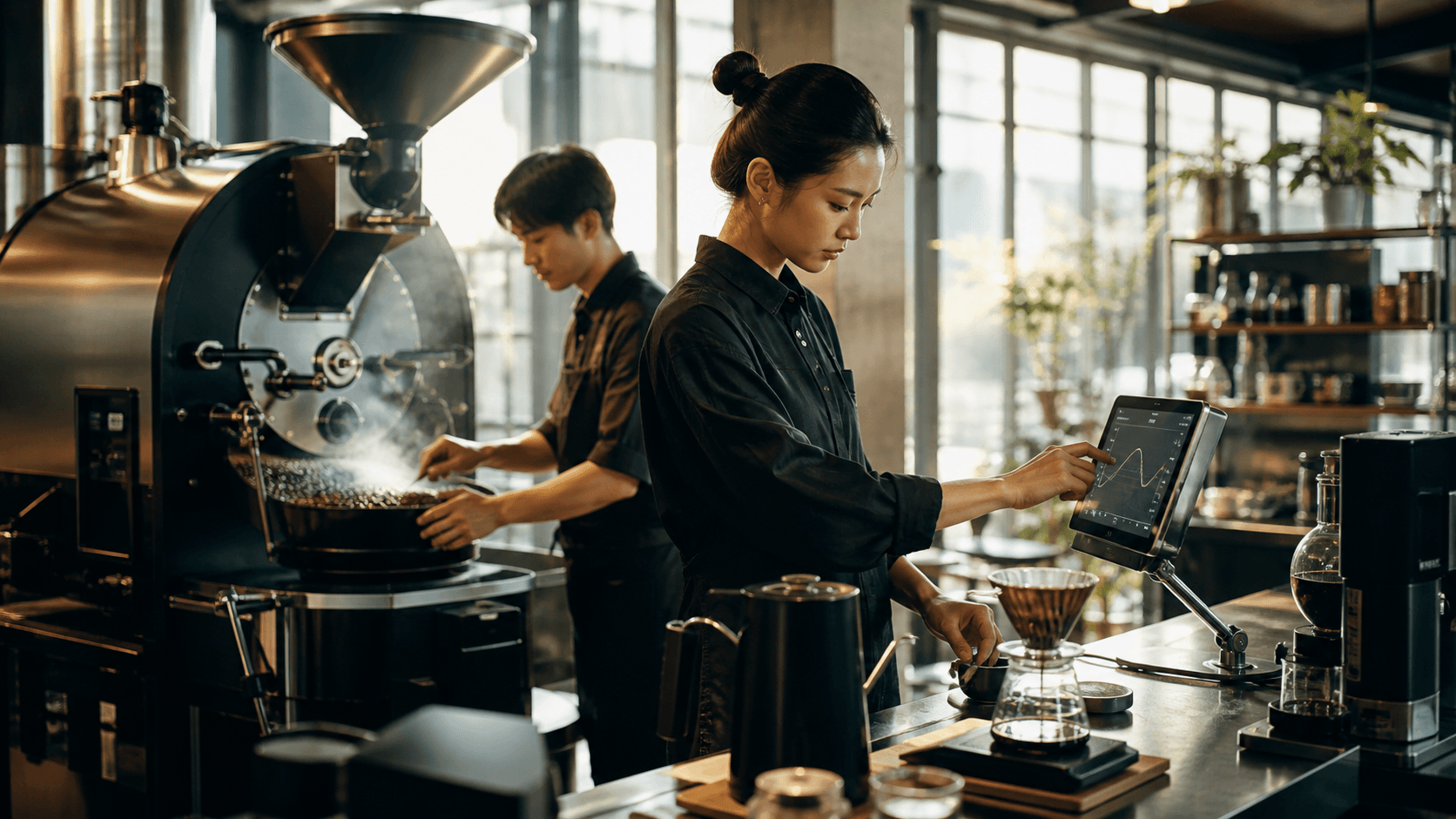
Roast sensing gives coffee roasters a more structured view of a process that is still partly art. Sensors and models can track variables such as temperature curves, time, airflow, and rate of rise, helping identify when a batch drifts from a preferred profile. For cafés that roast in-house, this can reduce inconsistency across batches and make corrective action faster. The same logic applies to grind and extraction control. If the grind is too fine, too coarse, or shifts with humidity, extraction changes in the cup; if the machine’s pressure or temperature wanders, the result does too. AI systems can help compare output against a chosen reference, flagging likely causes rather than asking staff to diagnose from taste alone. The limit is important: coffee quality is multi-variable and sensory-led, so models should be treated as decision support, not as an oracle. A good workflow combines measurements with cupping notes, tasting logs, and human override.
Quality prediction, maintenance, and the economics of fewer surprises
AI is also useful when it predicts operational risk before customers feel it. In a café, quality prediction can mean estimating whether beans are aging out of peak, whether a grinder needs calibration, or whether a machine is trending toward a fault. Equipment maintenance is especially relevant because espresso systems are sensitive to small mechanical changes. A predictive approach can prioritize cleaning, part replacement, and service calls based on observed behavior instead of fixed calendars alone. That can reduce downtime and avoid pouring money into emergency repairs. Waste reduction follows naturally: fewer discarded shots, fewer remade drinks, less over-ordering of beans, and better inventory decisions. But there is a tradeoff. Predictive systems rely on clean data, and bad inputs can produce confident-looking recommendations that are still wrong. Independent operators should measure whether maintenance alerts actually reduce failures, whether remake rates decline, and whether staff trust the system enough to use it consistently.
Barista judgment, provenance, and the part customers still taste
The craft that remains human is not a decorative add-on; it is part of the product. Barista judgment decides when to adjust a recipe for a particular origin, when a shot tastes balanced but not expressive enough, or when a guest’s preference should override a standard setting. Provenance matters here too. Customers increasingly care about where coffee comes from, how it was processed, and what that implies about flavor and ethics. AI can help organize farm, lot, and supply-chain information so it is easier to communicate transparently, but it cannot substitute for a trained person who can translate provenance into a sensory experience. In practice, the best cafés use AI to make the technical base steadier so that human judgment can focus on nuance, storytelling, and service.
An attainable pilot for independent cafés
For an independent coffee business, the most realistic starting point is a narrow pilot with one operational goal. Choose either roast consistency, espresso extraction stability, or equipment maintenance, and define a baseline before introducing any tool. Measure a small set of indicators: shot-to-shot variation, remake or discard rates, service interruptions, brew ratio consistency, or the number of days between calibration issues. Then connect the system to existing workflows rather than adding another dashboard staff must ignore. The pilot should be limited in scope, reviewed weekly, and judged on operational outcomes, not novelty. If the data are messy, start by improving logging discipline before buying more software. If the team does not trust recommendations, keep a human approval step. The aim is not to automate the café, but to make expertise easier to apply reliably.
A short action plan and the strategic bottom line
Start with one high-friction problem, one clear metric, and one responsible owner. Collect baseline data for a few weeks. Test AI support on a single process, such as roast-profile comparison or espresso anomaly detection. Compare the pilot against the baseline using practical measures: fewer reworks, fewer equipment surprises, and more consistent tasting outcomes. If the system helps, expand slowly; if it creates noise, step back. The broader lesson is straightforward: AI can improve precision and consistency in coffee making, but the long-term value comes from pairing it with human skill, provenance awareness, and hospitality. For independent cafés, that balance is not a compromise. It is the business model.
Sources & further reading
Primary reporting and references used to inform this analysis.
- 01International Federation of Robotics
AI in Robotics — Trends, Challenges, Commercial Applications - 02NHTSA
Automated Vehicle Safety - 03FAO
Digital Agriculture and AI Innovation - 04NIST
2026 Roadmap on Artificial Intelligence and Machine Learning for Smart Manufacturing - 05Bank for International Settlements
Intelligent financial system: how AI is transforming finance - 06PROMPERÚ
Marco normativo y regulatorio de la Inteligencia Artificial en Perú y su impacto en el comercio exterior
NexaSphere Perspective
Build what comes next.
Turn emerging AI capabilities into a secure, measurable growth system designed around your business.
Discuss your AI roadmap