Executive summary
AI logistics is not about replacing planners with algorithms. It is about giving supply chains earlier warning, better options, and faster escalation when conditions change. The business value comes from turning fragmented data into a shared decision system that can sense demand shifts, rebalance inventory, reroute shipments, and surface supplier risk before disruption becomes expensive. The companies that benefit most will treat AI as an operating layer, not a magic tool: they will invest in clean data, explicit decision rights, scenario planning, and measurable resilience.
The real promise of AI logistics is earlier, better decisions
The most valuable use of AI in logistics is not autonomy for its own sake. It is decision advantage. When a supply chain can sense demand shifts sooner, identify exceptions faster, and choose from credible alternatives before congestion or shortages spread, it gains options that competitors may not have. That matters because modern supply chains are less brittle than they used to be, but still exposed to weather, port delays, labor constraints, commodity swings, policy changes, and uneven customer demand. AI does not remove those uncertainties. It helps organizations see them sooner and respond with more discipline.
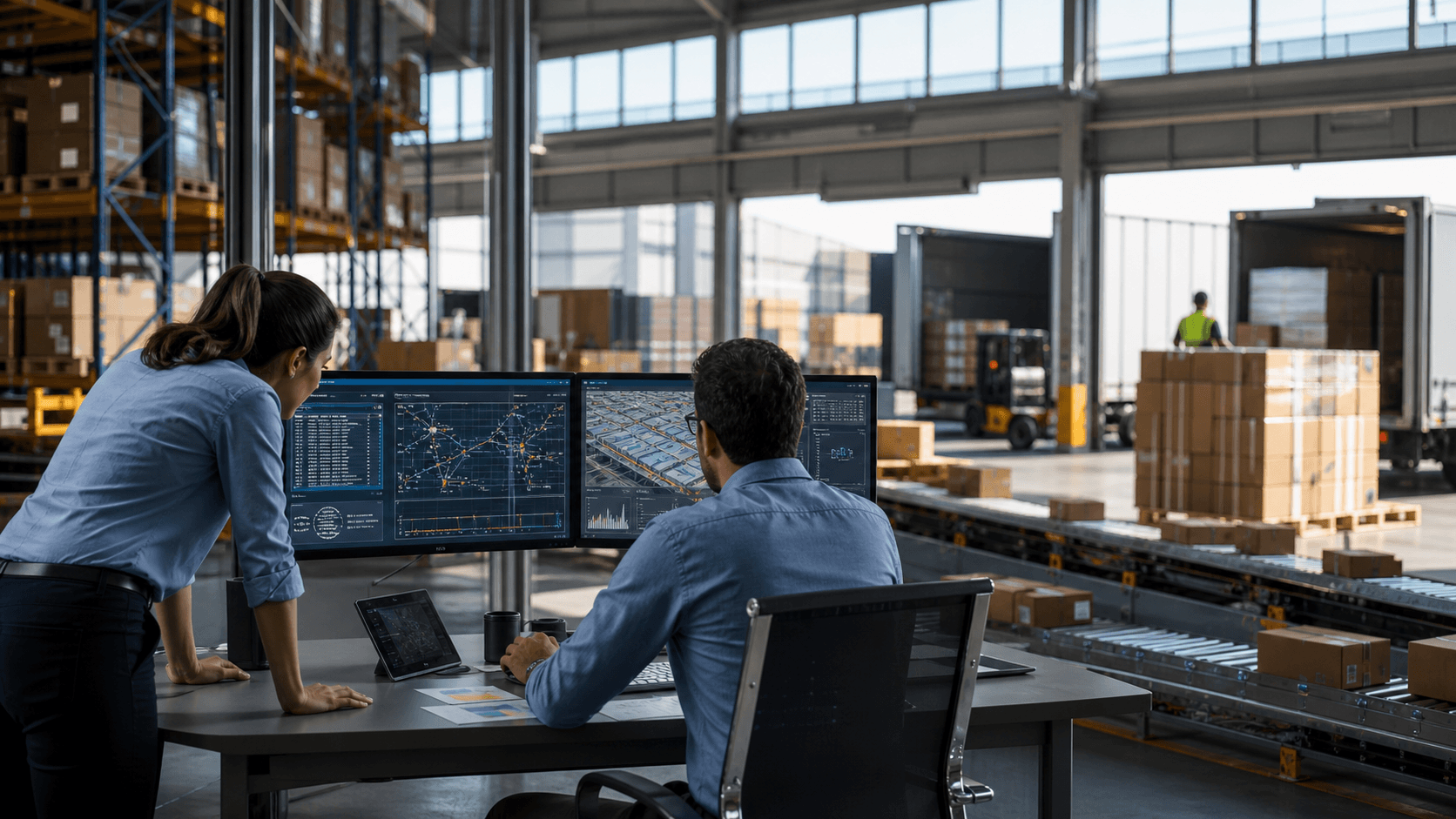
In practice, this means moving from a backward-looking control tower to a forward-looking operating model. Historical reports still matter, but they are not enough. AI can combine sales orders, point-of-sale signals, shipment telemetry, supplier performance, external events, and calendar effects to infer what is changing now. The business significance is straightforward: fewer surprise expedites, fewer stockouts, lower firefighting costs, and a better chance of protecting service levels without simply carrying excess inventory everywhere.
Demand sensing and inventory: from forecasts to living signals
Demand sensing is the short-horizon discipline of updating demand expectations using near-real-time signals. Unlike traditional forecasting, which often emphasizes seasonality and long-range patterns, demand sensing asks what is happening this week or this hour. Retail sell-through, channel inventory, web traffic, order cancellations, and regional events can all improve the picture. The point is not to replace planning models, but to refine them quickly enough that replenishment, production, and allocation decisions stay relevant.
Inventory is where these signals become financial reality. If a company can distinguish between stable demand, transitory spikes, and structural shifts, it can position stock more intelligently. That may mean holding more safety stock for critical items, reducing buffer on slow-moving goods, or moving inventory closer to demand centers before volatility increases. The tradeoff is important: more responsiveness usually requires more data quality, better master data, and a willingness to accept that a model’s recommendation should be challenged when commercial context changes. AI can narrow the error band, but it cannot eliminate the need for judgment about promotions, substitution, and customer priorities.
Routing, exception management, and the case for human decision rights
Routing is where AI often provides immediate operational value. It can evaluate lane performance, weather, carrier reliability, cost, transit time, carbon constraints, and service commitments at once. For routine shipments, rules can handle most decisions. For exceptions, AI can rank alternatives and flag the ones that matter most. That exception management layer is crucial because many supply chains do not fail from normal volume; they fail when a small number of problems remain hidden long enough to cascade.
Still, AI should not own every logistics decision. Human decision rights matter most when the choice affects customer commitments, regulatory exposure, supplier relationships, or brand risk. The better pattern is to define which recommendations are auto-executable, which require review, and which must be escalated immediately. This prevents both over-automation and analysis paralysis. It also gives planners a clear role: not just approving outputs, but improving the logic, constraints, and thresholds that shape those outputs.
Digital twins and scenario planning turn uncertainty into rehearsed options
A digital twin of the supply chain is a living model that mirrors key flows, constraints, capacities, and dependencies. It is not valuable because it looks impressive. It is valuable because it allows teams to test what happens if a port closes, a supplier misses a critical component, a SKU spikes unexpectedly, or a transportation lane becomes unreliable. When paired with AI, the twin can help compare scenarios quickly and identify bottlenecks before the real world exposes them.
Scenario planning is where strategic resilience is built. Companies should test not only obvious shocks, but combinations: demand surge plus supplier failure; transportation delay plus labor shortage; geopolitics plus raw-material scarcity. The aim is not prediction perfection. It is preparedness. Good scenario planning creates pre-approved playbooks, alternative suppliers, substitution logic, and inventory repositioning rules so response time does not depend on improvisation.
Supplier risk, data foundations, and how to measure resilience
Supplier risk is broader than on-time delivery. It includes financial fragility, geographic concentration, regulatory exposure, quality drift, cybersecurity risk, and single-source dependency. AI can help surface weak signals by monitoring purchase patterns, external news, shipment behavior, and network concentration. But supplier risk analysis is only as strong as the data behind it. If item masters are inconsistent, supplier identities are fragmented, or transaction records are incomplete, the model will produce confident-looking noise.
That is why data foundations come first: master data governance, clear event definitions, a common product hierarchy, clean supplier records, and consistent timestamps. Once those are in place, organizations can measure resilience more meaningfully. Useful metrics include time to detect an exception, time to decide, time to recover, service-level stability during disruption, inventory days at risk, forecast error by horizon, and the share of decisions that required human escalation. These measures show whether the supply chain is becoming more adaptive, not merely more automated.
The most resilient organizations will also accept tradeoffs. More sensing can mean more noise. More automation can mean less flexibility if rules are too rigid. More redundancy can improve continuity but raise cost. The right answer is not maximum efficiency or maximum buffer; it is an explicit balance between cost, service, and risk that can be adjusted as conditions change.
A practical action plan for the next 90 days
Start with one decision domain, such as demand sensing for a high-value product family or exception management for a critical shipping lane. Define the business question, the data sources, the escalation rules, and the owner of each decision. Clean the minimum viable data set before expanding the model. Then run scenario tests using recent disruptions as a baseline, so the organization can compare AI-supported recommendations with what actually happened.
Next, establish a resilience scorecard. Track not only cost and service, but detection speed, decision speed, and recovery speed. Review where humans overrode the system and whether the override improved the outcome. Finally, treat the first deployment as a learning loop rather than a finish line. AI logistics becomes durable when it is integrated into planning cadences, procurement reviews, and transportation operations—not when it sits as a disconnected dashboard. The goal is not a supply chain that never gets surprised. The goal is one that sees around corners often enough to stay in control.
Sources & further reading
Primary reporting and references used to inform this analysis.
- 01International Federation of Robotics
AI in Robotics — Trends, Challenges, Commercial Applications - 02NHTSA
Automated Vehicle Safety - 03FAO
Digital Agriculture and AI Innovation - 04NIST
2026 Roadmap on Artificial Intelligence and Machine Learning for Smart Manufacturing - 05Bank for International Settlements
Intelligent financial system: how AI is transforming finance - 06PROMPERÚ
Marco normativo y regulatorio de la Inteligencia Artificial en Perú y su impacto en el comercio exterior
NexaSphere Perspective
Build what comes next.
Turn emerging AI capabilities into a secure, measurable growth system designed around your business.
Discuss your AI roadmap