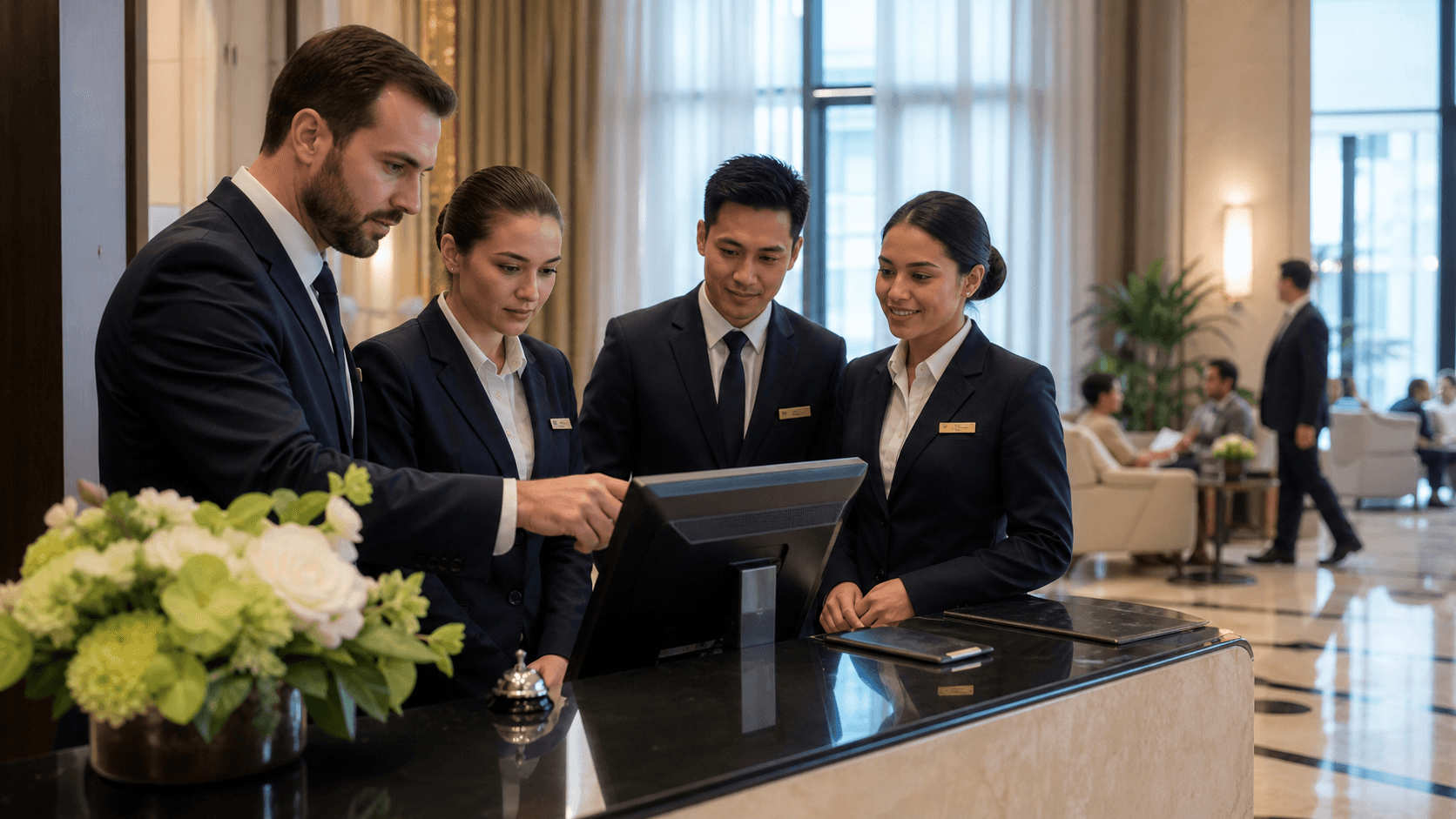
Executive summary
Hotels can use AI to sharpen demand planning, guest communication, housekeeping coordination, maintenance response, and personalization—but only if the technology stays in service of hospitality, not a substitute for it. The strongest operating model uses AI for speed, consistency, and prediction while keeping consent, accessibility, and emotionally sensitive moments firmly human.
The short answer: use AI to remove friction, not to replace hospitality
Hotels should use AI where it reduces delay, prevents errors, and helps staff act sooner: forecasting demand, prioritizing messages, coordinating housekeeping, flagging maintenance, and tailoring offers or room preferences. The business case is straightforward. Hospitality is labor-intensive, guest expectations are high, and small operational failures quickly become visible. AI can help teams work with better timing and more context, but the guest should still feel that a person, not a system, is responsible for the welcome. That distinction matters because hotel value is not only efficiency; it is reassurance, attention, and trust.
The challenge is to decide which interactions can be automated and which must remain human. A practical rule is this: let AI handle repetitive, high-volume, low-emotion tasks; keep human judgment for exceptions, sensitive requests, complaints, recovery moments, and any situation where empathy changes the outcome. That boundary preserves the brand promise while making operations more resilient.
Demand planning and staffing: where prediction helps most
Demand planning is one of the clearest use cases for AI in hotels. Forecasting tools can combine booking pace, length of stay, seasonality, day-of-week patterns, local events, flight arrivals, weather, and historical occupancy to suggest staffing and inventory levels. The point is not perfection; it is better decisions earlier. If a hotel can anticipate a busy arrival window, it can align front-desk coverage, housekeeping turn times, breakfast preparation, and maintenance scheduling before the rush begins.
Implementation works best when forecasts are treated as decision support, not automatic truth. Revenue managers, operations leaders, and department heads should review the model’s recommendations, compare them with local knowledge, and override them when the context changes. Measurement should include forecast accuracy, labor alignment, late-room readiness, and service recovery volume. The tradeoff is clear: a more predictive operation requires cleaner data, disciplined review, and staff trust in the system.
Guest messaging: faster responses, clearer boundaries
Guest messaging is another strong area for AI, especially before arrival and during routine stays. Hotels can use automated assistants to answer common questions about check-in times, amenities, parking, Wi-Fi, breakfast, and policy details. AI can also draft responses in the guest’s preferred language, route urgent issues to the right team, and summarize long message threads so staff do not start from zero every time. This improves response speed and consistency, which guests often interpret as care.
But messaging needs guardrails. Guests should know when they are interacting with automation, how to reach a person, and what the hotel does with their data. Personalization should be based on consent and relevance, not hidden inference. A guest who opts in to receive pillow or dining recommendations may appreciate them; a guest who did not consent may experience the same message as intrusive. Hotels should monitor response time, resolution time, escalation rates, and guest satisfaction by channel, while also reviewing message quality for tone and accuracy.
Housekeeping and maintenance: coordination is where AI earns trust
Inside the hotel, AI is often most valuable as a coordination layer. Housekeeping teams can benefit from task prioritization that reflects room status, stay patterns, early check-ins, late departures, and guest preferences. Maintenance teams can use AI to identify recurring issues, schedule preventive work, and connect guest complaints with room histories so repeat problems are fixed more quickly. In both cases, the goal is fewer surprises and less back-and-forth.
The limits are important. No model should be allowed to mask a physical inspection or replace a technician’s judgment. AI can suggest that a room needs attention, but a person must confirm the condition. Likewise, cleaning standards should not be reduced to speed metrics alone. Hotels should measure room readiness, defect recurrence, work-order closure time, and staff time spent on coordination. If AI saves time but increases rework, the implementation has missed the point.
Personalization, consent, accessibility, and the moments that stay human
Personalization is useful when it helps the guest feel recognized without feeling monitored. That means storing preferences carefully, explaining why data is collected, and allowing easy opt-in and opt-out. The best personalization is often modest: room type preferences, language choice, dining timing, mobility needs, allergy notes, or communication channel preferences. More data does not always mean better service; it can also increase risk and operational complexity.
Accessibility deserves equal attention. AI tools should support screen readers, multilingual communication, readable formatting, and alternative contact methods for guests who cannot or do not want to use a mobile app. Hospitality also has moments that should remain unmistakably human: checking in a distressed guest, handling a complaint, welcoming a first-time visitor, resolving a safety issue, or making a discretionary service recovery decision. These are not inefficiencies to eliminate; they are the core of the brand experience. A hotel that automates everything risks becoming fast but forgettable.
A practical action plan for hotel leaders
Start with one workflow in each of four areas: demand planning, guest messaging, housekeeping, and maintenance. Define the problem, the people responsible, the data required, and the exact decision the AI will support. Put consent and privacy language in place before deployment. Test the workflow with staff first, then with a small guest segment, and review both operational and experience metrics. Keep a fallback path for manual handling at all times.
The right question is not whether AI belongs in hotels. It already does. The real question is whether it will be used to make the hotel more attentive, accessible, and dependable—or merely more automated. Hotels that preserve the human welcome while using AI to remove friction are more likely to build loyalty, protect staff time, and deliver service that feels personal without pretending that machines can host on their own.
Sources & further reading
Primary reporting and references used to inform this analysis.
- 01International Federation of Robotics
AI in Robotics — Trends, Challenges, Commercial Applications - 02NHTSA
Automated Vehicle Safety - 03FAO
Digital Agriculture and AI Innovation - 04NIST
2026 Roadmap on Artificial Intelligence and Machine Learning for Smart Manufacturing - 05Bank for International Settlements
Intelligent financial system: how AI is transforming finance - 06PROMPERÚ
Marco normativo y regulatorio de la Inteligencia Artificial en Perú y su impacto en el comercio exterior
NexaSphere Perspective
Build what comes next.
Turn emerging AI capabilities into a secure, measurable growth system designed around your business.
Discuss your AI roadmap